Wednesday, 6 November 2013

Forging

Forging is the process by which metal is heated and is shaped by plastic deformation by suitably applying compressive force. Usually the compressive force is in the form of hammer blows using a power hammer or a press.
Forging refines the grain structure and improves physical properties of the metal. With proper design, the grain flow can be oriented in the direction of principal stresses encountered in actual use. Grain flow is the direction of the pattern that the crystals take during plastic deformation. Physical properties (such as strength, ductility and toughness) are much better in a forging than in the base metal, which has, crystals randomly oriented.
Forgings are consistent from piece to piece, without any of the porosity, voids, inclusions and other defects. Thus, finishing operations such as machining do not expose voids, because there aren't any. Also coating operations such as plating or painting are straightforward due to a good surface, which needs very little preparation.
Forgings yield parts that have high strength to weight ratio-thus are often used in the design of aircraft frame members.
A Forged metal can result in the following
  • Increase length, decrease cross-section, called drawing out the metal.
Decrease length, increase cross-section, called upsetting the metal.
Change length, change cross-section, by squeezing in closed impression dies. This results in favorable grain flow for strong parts


Open Die Forging


Open die forging involves the shaping of heated metal parts between a top die attached to a ram and a bottom die attached to a hammer anvil or press bed. Metal parts are worked above their recrystallization temperatures-ranging from 1900°F to 2400°F for steel-and gradually shaped into the desired configuration through the skillful hammering or pressing of the work piece.

While impression or closed die forging confines the metal in dies, open die forging is distinguished by the fact that the metal is never completely confined or restrained in the dies. Most open die forgings are produced on flat dies. However, round swaging dies, V-dies, mandrels, pins and loose tools are also used depending on the desired part configuration and its size.

Although the open die forging process is often associated with larger, simpler-shaped parts such as bars, blanks, rings, hollows or spindles, in fact it can be considered the ultimate option in "custom-designed" metal components. High-strength, long-life parts optimized in terms of both mechanical properties and structural integrity are today produced in sizes that range from a few pounds to hundreds of tons in weight. In addition, advanced forge shops now offer shapes that were never before thought capable of being produced by the open die forging process.


Other Topics


Friday, 1 November 2013

Squeeze Casting

The process is suitable for components with relatively thick wall sections with high mechanical properties, as for example required of safety components in automotive engineering. The cast components can be welded and heattreated, and they can be produced with near net shape. Aluminum alloys can be used which are difficult or impossible to produce by standard die casting.

Buhler selectively utilizes the advantages of the horizontal shot sleeve system.
Advantages using Buhler machines

• The velocity and pressure intensification profile matched to the component geometry can be programmed in very many discrete steps. Real time control maintains these parameters constant.
• Depending on the type of shot unit selected, it is possible to generate high pressure intensification values during the solidification phase.

Your benefits
• Low capital investment, as no special-purpose machines are required.
• Entering of future-oriented market segments using existing SC machines.
• Low maintenance and training requirements thanks to unified machine and die ranges.

Cold Chamber Process


The essential feature of this process is the independent holding and injection units. In the cold chamber process metal is transferred by ladle, manually or automatically, to the shot sleeve. Actuation of the injection piston forces the metal into the die. This is a single-shot operation. This procedure minimizes the contact time between the hot metal and the injector components, thus extending their operating life. However, the turbulence associated with high-speed injection is likely to entrain air in the metal, which can cause gas porosity in the castings. The cold chamber process is used for the production of aluminum and copper base alloys and has been extended to the production of steel castings. Next to zinc aluminum is the most widely used die-casting alloy. The primary advantage is it light weight and its high resistance to corrosion. Magnesium alloy die-castings are also produced and are used where a high strength–to–weight ratio is desirable.
The mold has sections, which include the “cover” or hot side and the “movable” or ejector side. The die may also have additional moveable segments called slides or pulls, which are used to create features such as undercuts or holes which are parallel to the parting line. The machines run at required temperatures and pressures to produce a quality part to near net-shape.


Some application for Aluminum Die Castings:
o Automotive industry
o Home Appliances
o Communication Equipment
o Sports & Leisure


Other Topics

Sandy loam soils

Sandy loam soils are dominated by sand particles, but contain enough clay and sediment to provide some structure and fertility. There are four different types of sandy loam soil that are classified based on the size of the sand particles in the soil. You can determine whether your yard has this kind of soil using a simple test.

Classification

Sandy loam soils are broken down into four categories, including coarse sandy loam, fine sandy loam, sandy loam and very fine sandy loam. The size of the sand particles is measured in millimeters and their concentration in the soil is used to determine which category a soil falls under. Sandy loam soils are made of approximately 60 percent sand, 10 percent clay and 30 percent silt particles.

Characteristics

Sandy loam soils have visible particles of sand mixed into the soil. When sandy loams soils are compressed, they hold their shape but break apart easily. Sandy loam soils have a high concentration of sand that gives them a gritty feel. In gardens and lawns, sandy loam soils are capable of quickly draining excess water but can not hold significant amounts of water or nutrients for your plants. Plants grown in this type of soil will require more frequent irrigation and fertilization than soils with a higher concentration of clay and sediment. Sandy loam soils are often deficient in specific micronutrients and may require additional fertilization to support healthy plant growth.

Identification

You can quickly identify sandy loam soil based on its physical characteristics. Pick up a handful of dry soil and slowly dribble water onto it. Work the water into the soil with your hand until it has a smooth consistency similar to putty. Hold the soil in your hand as though you are holding a pipe straight up and down and squeeze it. Sandy loam soils have a very gritty texture. If your soil is a sandy loam, it will form a cohesive ribbon of soil as it squeezes out between your thumb and finger that will fall apart before it reaches one inch in length.

Considerations

Plants that are grown in a sandy loam soil need frequent irrigation and fertilization to maintain healthy growth. The best way to improve a sandy loam soil for gardening is to mix organic matter into the soil. Incorporating a 2- to 4-inch layer of compost or peat moss over the area can significantly improve the ability of your sandy loam soil to hold nutrients and water.

Facing Sand

A sand casting facing composition comprises a dry mixture of about 77% fine sand, 5% binder, 6% green system sand and 12% burned system sand. The fine sand is mulled with 5.8% wt/wt oil per total dry mixture and catalyst at about 0.5% wt/wt. Preferably, fine sand and binder are mulled with oil, catalyst, green system sand and screened burned system. The mulled mixture is rested, mulled again and rested again before use as facing sand for achieving accurate reproduction of the pattern's fine detail. A method of preparing the mold and preserving fine detail comprises riddling the pattern with a thin layer of the facing sand composition, compacting, riddling with dry system sand and riddling with system sand before compacting about the periphery of the pattern. Final layers of system sand are applied and compacted over the entire pattern.

Green Sand

Greensand is a naturally occurring mineral mined from ocean deposits from a sedimentary rock known as "Glauconite". It is often an olive-green colored sandstone rock found in layers in many sedimentary rock formations.

Origin of Greensand
Greensand forms in anoxic (without oxygen) marine environments that are rich in organic detritus and low in sedimentary inputs. Some greensands contain marine fossils (i.e. New Jersey Greensand). Greensand has been found in deposits all over the world.
The greenish color comes from the mineral glauconite and iron potassium silicate that weathers and breaks down releasing the stored minerals. The color may range from a dark greenish gray, green-black to blue-green depending on the minerals and water content. It often weathers easily and forms nodules that have been oxidized with iron bearing minerals that has a reddish brown or rust color.
The major chemical description is ((K,Na)(Fe+3, Al, Mg)2(Si,Al)4O10(OH)2)
General chemical information:
Iron (Fe) 12-19%
Potassium (K) 5-7%
Silicon (Si) 25.0%
Oxygen (O) 45%
Magnesium (Mg) 2-3 %
Aluminum (Al) 1.9 %
Sodium (Na) 0.27%
Hydrogen (H) 0.47%
Over 30 other trace minerals and many micronutrients.

Types of Greensand
Glauconite is the name given to a group of naturally occurring iron rich silica minerals that may be composed of pellets or grains.
When glauconite is mined the upper layers that have weathered and become oxidized and minerals are released. These sometimes form pyrite a iron sulfide (FeS2) when oxygen is absent. In the deeper layers or reduced zone pyrite crystals often form. Other minerals found by magnetic separation are Zn, Ni, Cu, and many trace minerals and micronutrients.
The potassium (K) is often found in potassium saturated layers of mica, vermiculite and montmorillonite. Greensand is often considered a clay mineral due to the presence of chlorite, kaolinite, vermiculite, and other clay minerals that may be present.
Greensand is a very heavy mineral with a density of approximately 90 pounds per cubic foot (over 1 ton per cubic yard). The minerals are normally released slowly over time but occur much faster in organic rich soils full of beneficial microbes (microbes produce organic acids as they break down organic matter which facilitates the release of the minerals for plant absorption).
The pH of greensand varies from slightly acidic to slightly alkaline depending on the source and has little effect on soils.

Sources of Greensand
Greensand deposits are found all over the world with the largest and most numerous deposits in the United States and in Great Britain. The original deposits used in Horticulture were from the New Jersey area. In recent years several deposits have been found scattered from East Texas near Lufkin to West of San Antonio and in Arkansas.

Uses of Greensand
Greensand has been used for over 100 years as a natural source of slow release fertilizer and soil conditioner. The slow release of potash and phosphate does not burn plants and the minerals improve the moisture holding properties of soil. The best deposits of greensand contain at least 90% of the mineral glauconite and less than 2-3% clay minerals.
The cation exchange capacities (CEC) of soils were found to increase as the weathering of the greensand increased. The mineral glauconite is used as a water softener and it very beneficial to fight chlorosis in iron deficient soils.
Greensand often has the consistency of sand but is able to absorb 10 times more moisture which makes it a good amendment for use in agriculture and horticulture for many soils types. Greensand does not burn plants and helps for beneficial microbes to grow in the soil. It also has been found to be a good conditioner to help loosen heavy and tight soils and help bind loose soils.
Greensand is often used in compost piles to increase the nutrient content and diversity of beneficial microbes.
Recommended application is 2-4 pounds of greensand per 100 square feet or 1 ton per acre. For potting soils 5-20 pounds per cubic yard can be beneficial.
A field test by Rutgers University in a sandy loam soil with greensand applied in the row at the time of planting, found that the application of greensand increased the yield of potatoes by 16%.
The benefits of greensand, largely unexplained by scientific research are far more than a laboratory analysis would indicate. However numerous greenhouse and field studies have shown significant improvement in the growth of plants. Other studies have shown that the use of greensand improves the taste, color, nutritional value, the health of plants and the health of soils.


Other Topics
IC engine, Air Standard Cycles, Method of Ignition, Gear Types, mechanical Engineering, Gears, spur gears,Worm gears,English books,Photoshop tutorials,Physics files,Thamizh,Manufacturing,Gears pdf,Computer science,Harry potter,Best 100 english books,Face Gears,IC engine,Metal Casting,Sand casting,SAND Casting Quiz,Casting patterns quiz,Sand Casting Process,Patterns,Mechnical Previous Years Gate Question Papers ,Mechanical-old-question-paper,Core and Core Box,Shell Moulding,Permanent mold casting,Investment Casting,Die Casting,Centrifugal Casting,Workshop Technology Quiz,Milling Quiz,Metal Quiz,Mechanical Process Quiz,Chemically Bonded Molding Systems,Unbonded Sand Processes,Green Sand Molding,Gases Iin Metal Casting,Plaster Mold Casting,Ceramic Mold Casting,Vacuum Casting,Hot Chamber Die Casting,Continuous Casting,Casting Process Quiz,Types Of Molding Sand In Casting-process,Green Sand

Types of Molding sand in Casting Process

Types of molding sand:

 
types of molding sand in casting process

  Green sand:

                                 Natural sand with moisture

 Dry sand:

                                Not suitable for large castings

Facing sand:

This sand is used directly next to the surface of the pattern and comes into contact with the molten metal when the mould is poured.
As a result, it is subjected to the severest conditions and must possess, therefore, high strength and refractoriness. This sand also provides a smoother casting surface and should be of fine texture. It is made of silica sand and clay, and some additives without the addition of used sand.
Facing sand is always used to make dry sand moulds while system sand is frequently used for green sand molding.

Parting sand:

This sand is used to prevent adhering of two halves of mould surfaces in each molding box when they are separated. Thus, to ensure good parting, the mould surface (at contact of cope and Drag) should be treated with parting sand or some other parting material.
It is also sprinkled or applied on the pattern surface (before the molding sand is put over it) to avoid its sticking and permit its easy withdrawal from the mould. The parting sand is fine dry sand.

Backing or floor or black sand:

This is the sand which is used to back up the facing sand and to fill the whole volume of the flask. Old, repeatedly used molding sand is mainly employed for this purpose.             

  Core sand:

                                The core sand mainly consists of silica sand and an organic binder, with very little, if any, clay content. The presence of clay in core sand reduces its permeability and collapsibility. The core sand may contain small percentages of other constituents also, to enhance its properties.            

 Loam sand:

                                50 % of clay and dried hard and using for large castings


Wednesday, 30 October 2013

Casting Process Quiz


Other Topics
IC engine, Air Standard Cycles, Method of Ignition, Gear Types, mechanical Engineering, Gears, spur gears,Worm gears,English books,Photoshop tutorials,Physics files,Thamizh,Manufacturing,Gears pdf,Computer science,Harry potter,Best 100 english books,Face Gears,IC engine,Metal Casting,Sand casting,SAND Casting Quiz,Casting patterns quiz,Sand Casting Process,Patterns,Mechnical Previous Years Gate Question Papers ,Mechanical-old-question-paper,Core and Core Box,Shell Moulding,Permanent mold casting,Investment Casting,Die Casting,Centrifugal Casting,Workshop Technology Quiz,Milling Quiz,Metal Quiz,Mechanical Process Quiz,Chemically Bonded Molding Systems,Unbonded Sand Processes,Green Sand Molding,Gases Iin Metal Casting,Plaster Mold Casting,Ceramic Mold Casting,Vacuum Casting,Hot Chamber Die Casting,Continuous Casting,Casting Process Quiz

Continuous casting

Continuous casting, also referred to as strand casting, is a process used in manufacturing industry to cast a continuous length of metal. Molten metal is cast through a mold, the casting takes the two dimensional profile of the mold but its length is indeterminate. The casting will keep traveling downward, its length increasing with time. New molten metal is constantly supplied to the mold, at exactly the correct rate, to keep up with the solidifying casting. Industrial manufacture of continuous castings is a very precisely calculated operation. Continuous casting can produce long strands from aluminum and copper, also the process has been developed for the production of steel.


The Process

Molten metal, from some nearby source, is poured into a tundish. A tundish is a container that is located above the mold, it holds the liquid metal for the casting. This particular casting operation uses the force of gravity to fill the mold and to help move along the continuous metal casting. The tundish is where the operation begins and is thus located high above ground level, as much as eighty or ninety feet. As can be seen, the continuous casting operation may require a lot of space.
It is the job of the tundish to keep the mold filled to the right level throughout the manufacturing operation. Since the metal casting is constantly moving through the mold, the tundish must always be supplying the mold with more molten metal to compensate.
The supplying of metal to the mold is not only going on throughout the entire manufacturing operation, it must be carried out with accuracy. A control system is employed to assist with this task. Basically the system can sense what the level of molten metal is, knows what the level should be, and can control the pouring of the metal from the tundish to ensure the smooth flow of the casting process. Although the tundish can typically hold several thousand pounds of metal, it too must be constantly supplied from the source of molten material.
The tundish also serves as the place where slag and impurities are removed from the melt. The high melting point and reactive nature, at high temperatures, has always made steel a difficult material to cast. When a manufacturing operation is continuously casting steel, the reactivity of the molten steel to the environment needs to be controlled. For this purpose, the mold entrance may be filled with an inert gas such as argon. The inert gas will push away any other gases, such as oxygen, that may react with the metal. There is no need to worry about the inert gas reacting with a molten metal melt, since inert gases do not react with anything at all.
The metal casting moves quickly through the mold, in the continuous manufacture of the metal part. The casting does not have time to solidify completely in the mold. As can be remembered from our discussion on solidification, a metal casting will first solidify from the mold wall, or outside of the casting, then solidification will progress inward. The mold in the continuous casting process is water cooled, this helps speed up the solidification of the metal casting. As stated earlier, the continuous casting does not completely harden in the mold. It does, however, spend enough time in the water cooled mold to develop a protective solidified skin of an adequate thickness on the outside.
The long metal strand is moved along at a constant rate, by way of rollers. The rollers help guide the strand and assist in the smooth flow of the metal casting out of the mold and along its given path. A group of special rollers may be used to bend the strand to a 90 degree angle. Then another set will be used to straighten it, once it is at that angle. Commonly used in manufacturing industry, this process will change the direction of flow of the metal strand from vertical to horizontal.
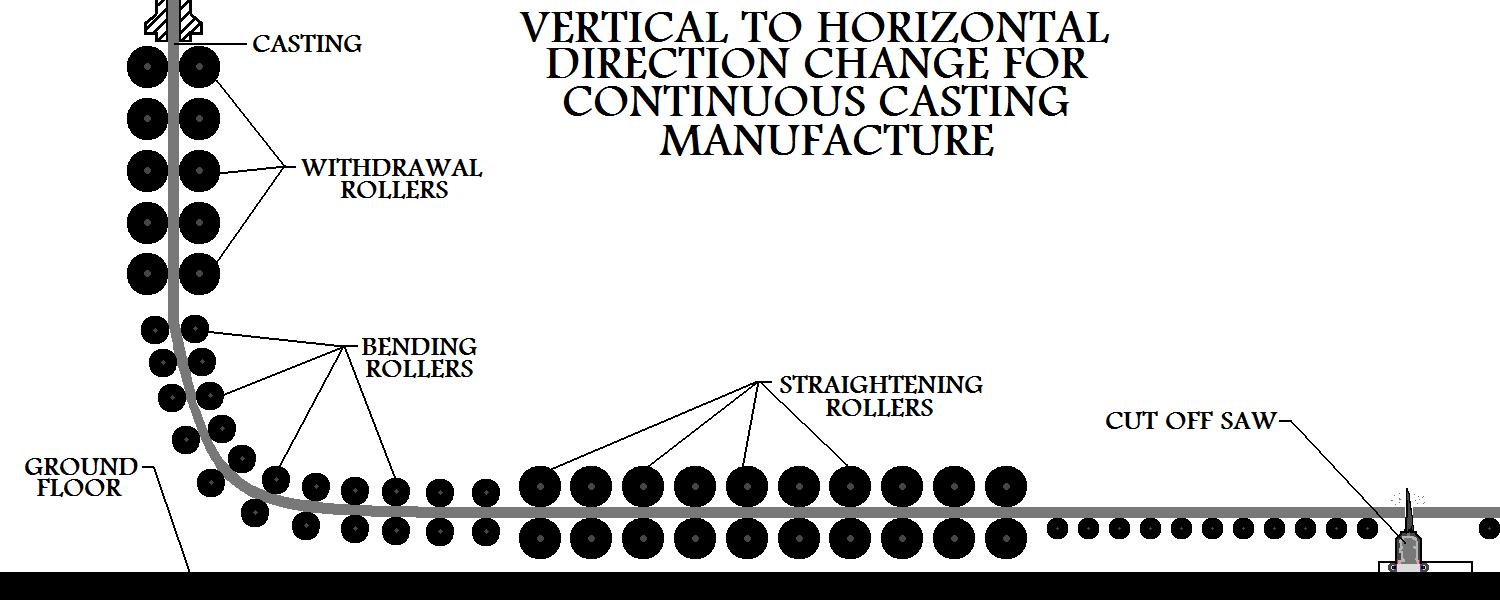


Vertical 
To Horizontal Direction Change For A Continuous Casting Operation


The continuous casting can now travel horizontally as far as necessary. The cutting device, in manufacturing industry, is typically a torch or a saw. Since the metal casting does not stop moving, the cutting device must move with the metal casting, at the same speed, as it does its cutting. There is another commonly used setup for cutting lengths of metal casting strand from a continuous casting operation. This particular manufacturing setup eliminates the need for bending and straightening rollers. It does, however, limit the length of metal casting strand that may be produced, based in a large part on the height of the casting floor where the mold is located.
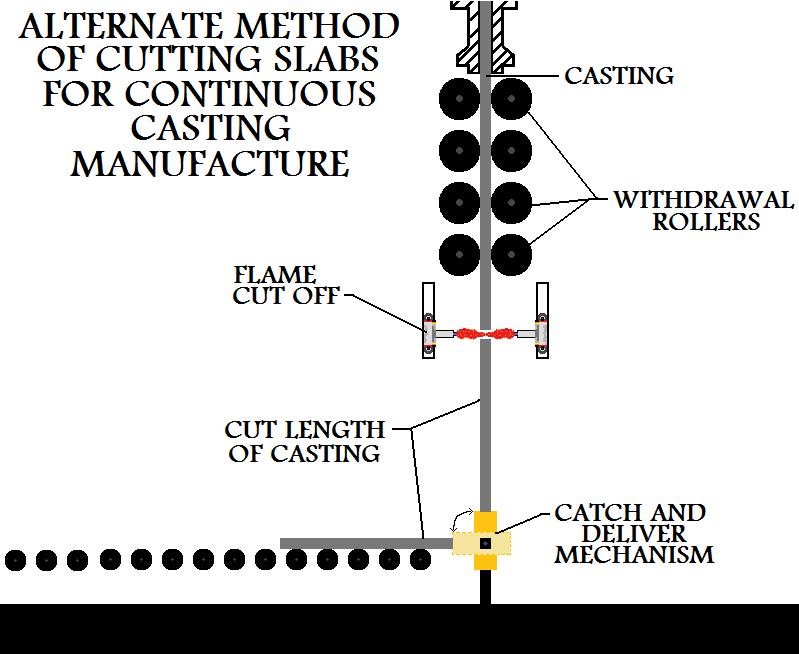


Alternate 
Method Of Cutting Slabs For Continuous Casting Manufacture


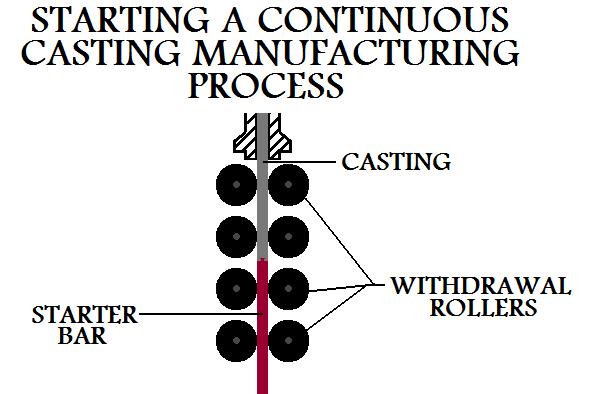
There needs to be an initial setup for a continuous casting operation, since you can not just pour molten metal through an empty system to start off the process. To begin continuous casting manufacture, a starter bar is placed at the bottom of the mold. Molten material for the metal casting is poured into the mold and solidifies to the bar. The bar gives the rollers something to grab onto initially. The rollers pull the bar, which pulls along the continuous casting.


Starting A 
Continuous Casting Manufacturing Process


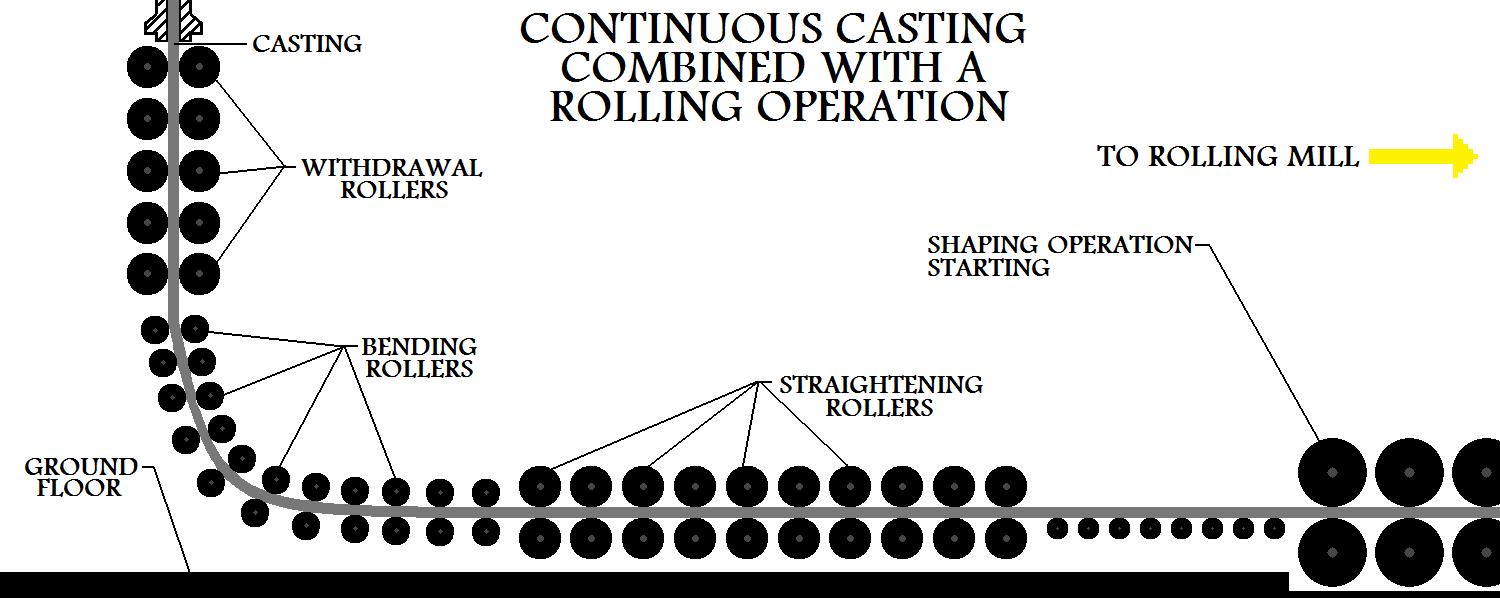
In the manufacture of a product, often two or more different kinds of operations may need to be performed. Such as a metal casting operation followed by a metal forming operation. In modern commercial industry, the continuous casting process can be integrated with metal rolling. Do not confuse the rolling operation with the rolls used to guide the casting. The rolling operation is a forming process and it will change the metal it processes. Rolling of the metal strand, is the second manufacturing process and it must be performed after the casting operation. Continuous casting is very convenient in that the rolling mill can be fed directly from the continuously cast metal casting strand. The metal strand can be rolled directly into a given cross sectional shape such as an I beam. The rate of the rolling operation is synchronized with the speed that the continuous metal casting is produced and thus the two operations are combined as one.


Continuous 
Casting Combined With A Rolling Operation


Properties And Considerations Of Manufacturing By Continuous Casting

  • Continuous casting manufacture is different from other metal casting processes, particularly in the timing of the process. In other casting operations, the different steps to the process such as the ladling of metal, pouring, solidification, and casting removal all take place one at a time in a sequential order. In continuous casting manufacture, these steps are all occurring constantly and at the same time.

  • This process is used in commercial manufacture as a replacement to the traditional process of casting ingots.

  • Piping, a common problem in ingot manufacture, is eliminated with the continuous casting process.

  • Structural and chemical variations in the metal of the casting, often present in ingots, have been eliminated. When manufacturing with the continuous metal casting process, the casting's material will possess uniform properties.

  • When employing continuous metal casting manufacture, the castings will solidify at 10 times the rate that a casting solidifies during ingot production.

  • With less loss of material, cost reduction, higher productivity rate, and superior quality of castings, continuous casting manufacture is often the choice over ingot production.

  • A continuous casting manufacturing process will take considerable resources and planning to initiate, it will be employed in only very serious industrial operations.


Other Topics
IC engine, Air Standard Cycles, Method of Ignition, Gear Types, mechanical Engineering, Gears, spur gears,Worm gears,English books,Photoshop tutorials,Physics files,Thamizh,Manufacturing,Gears pdf,Computer science,Harry potter,Best 100 english books,Face Gears,IC engine,Metal Casting,Sand casting,SAND Casting Quiz,Casting patterns quiz,Sand Casting Process,Patterns,Mechnical Previous Years Gate Question Papers ,Mechanical-old-question-paper,Core and Core Box,Shell Moulding,Permanent mold casting,Investment Casting,Die Casting,Centrifugal Casting,Workshop Technology Quiz,Milling Quiz,Metal Quiz,Mechanical Process Quiz,Chemically Bonded Molding Systems,Unbonded Sand Processes,Green Sand Molding,Gases Iin Metal Casting,Plaster Mold Casting,Ceramic Mold Casting,Vacuum Casting,Hot Chamber Die Casting,

Hot Die Casting

Hot chamber die casting is one of the two main techniques in the manufacturing process of die casting. This section will primarily discuss the specific details of the hot chamber process and contrast the differences between hot chamber die casting and cold chamber die casting, which is the other branch of die casting manufacture.

Hot Chamber Process

A similar characteristic of either die casting process is the use of high pressure to force molten metal through a mold called a die. Many of the superior qualities of castings manufactured by die casting, (such as great surface detail), can be attributed to the use of pressure to ensure the flow of metal through the die. In hot chamber die casting manufacture, the supply of molten metal is attached to the die casting machine and is an integral part of the casting apparatus for this manufacturing operation.


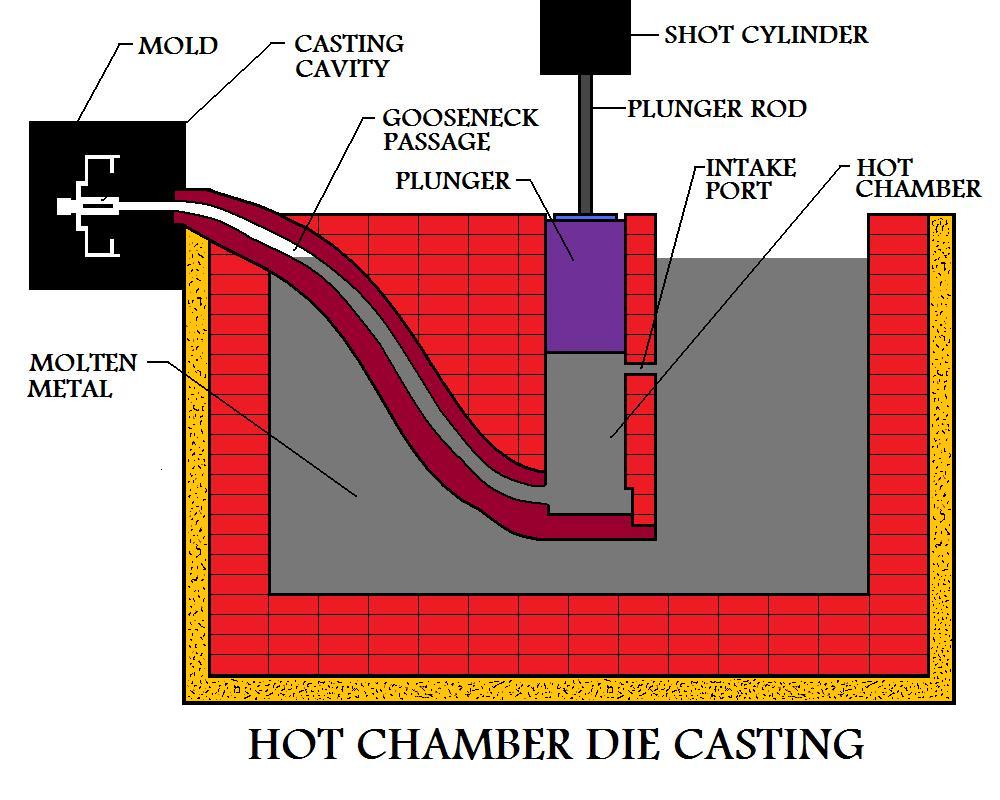
Hot Die Casting 
Operation Is Ready


The shot cylinder provides the power for the injection stroke. It is located above the supply of molten metal. The plunger rod goes from the shot cylinder down to the plunger, which is in contact with the molten material. At the start of a casting cycle, the plunger is at the top of a chamber (the hot-chamber). Intake ports allow this chamber to fill with liquid metal.
As the cycle begins, the power cylinder forces the plunger downward. The plunger travels past the ports, cutting off the flow of liquid metal to the hot chamber. Now there should be the correct amount of molten material in the chamber for the "shot" that will be used to fill the mold and produce the casting.

At this point the plunger travels further downward, forcing the molten metal into the die. The pressure exerted on the liquid metal to fill the die in hot chamber die casting manufacture usually varies from about 700psi to 5000psi (5MPa to 35 MPa). The pressure is held long enough for the casting to solidify.

In preparation for the next cycle of casting manufacture, the plunger travels back upward in the hot chamber exposing the intake ports again and allowing the chamber to refill with molten material.

For more extensive details on the setup of the mold, the die casting process, or the properties and considerations of manufacturing by die casting see die casting for the basics of the process.
Hot chamber die casting has the advantage of a very high rate of productivity. During industrial manufacture by this process one of the disadvantages is that the setup requires that critical parts of the mechanical apparatus, (such as the plunger), must be continuously submersed in molten material. Continuous submersion in a high enough temperature material will cause thermal related damage to these components rendering them inoperative. For this reason, usually only lower melting point alloys of lead, tin, and zinc are used to manufacture metal castings with the hot chamber die casting process

SLUSH MOLDING PROCESS

Slush molding is an excellent method of producing open, hollow objects,including rain boots, shoes, toys, dolls and automotive products, such as protective skin coatings on arm rests, head rests and crash pads. The basic process of slush molding involves exposing a hollow mold to heat, filling a hollow mold with vinyl plastisol or vinyl powder compound, gelling an innerlayer or wall of plastisol or partially fused powder  compound in the mold, inverting the mold to pour out the excess liquid plastisol or unfused powder
compound and then heating the mold again to fuse the vinyl compound which remains in the mold. The mold is then cooled and the finished part is removed.

Slush molding can be a simple hand operation for limited production, or an elaborate conveyorized system for long runs. This process can be a one pour method, where finished or semi-finished products can be made by one slushing step, or a multiple-pour method where two or more slushing steps are used.

The wall thickness of the slush molded part, made from powder compound at a given oven temperature, is determined by several factors: the thickness of the metal wall of the mold, the length of time the mold is preheated, and the amount and type of plasticizer in the compound.

Molds used in slush molding are produced from spun, machined or electroformed aluminum. Vinyl
powder compound will reproduce the surface finish of the mold, whether matte or glossy. Mold porosity, depending upon severity, may cause such detrimental effects as surface gloss reduction, pinholing, and voids in the molded part.


Other Topics

Physics basic inventions and inventors

1.Which instrument is used to measure altitudes in aircraft's ? Audiometer Ammeter Altimeter Anemometer Explanation : ...